
New Article on Disability Accomodation Stigma
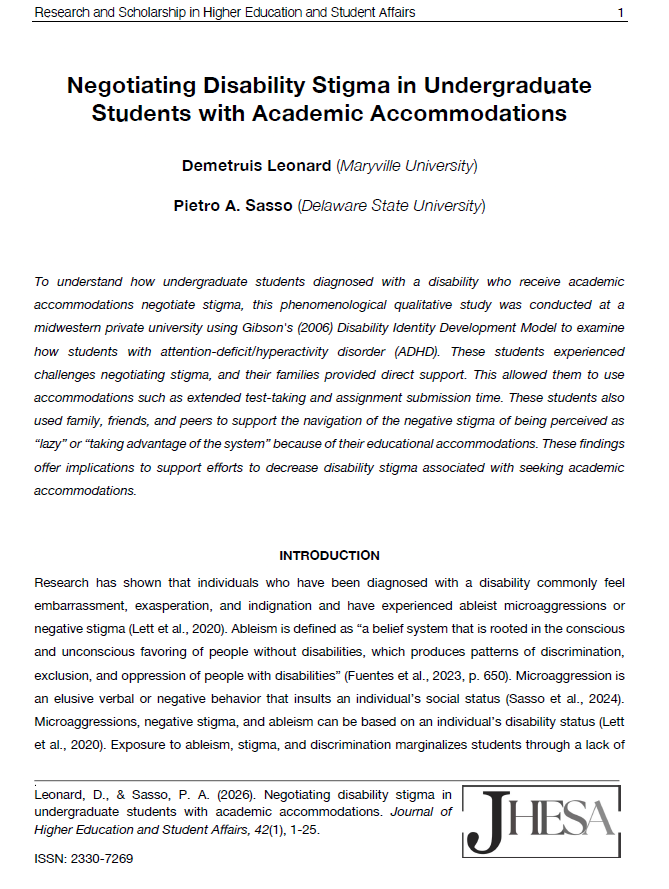
“Negotiating Disability Stigma in Undergraduate Students with Academic Accommodations” appears in the Journal of Higher Education & Student Affairs. I published with one of my doctoral students again. Dr. Demetruis Leonard (Maryville University) and I examined how undergraduates with diagnosed disabilities navigate stigma while using academic accommodations. Guided by Gibson’s Disability Identity Development Model, the phenomenological study explored students’ decisions about accommodations and their perceptions of their usefulness.
We interviewed six full-time undergraduates at a private Midwestern university. Participants primarily reported ADHD, anxiety, depression, autism, and neurological disabilities. Common accommodations included extended time for examinations and assignments and private testing rooms. Three themes emerged: experiences with time and location accommodations, family influence on disability identity, and microaggressions. Participants generally viewed accommodations as beneficial because they reduced anxiety, improved organization, supported academic performance, and provided quieter testing environments. However, some hesitated to use them because they feared appearing lazy, less capable, or as though they were taking advantage of the system. Family support often helped students understand, accept, and advocate for their disability-related needs, while peers with similar experiences also provided meaningful emotional support. Faculty comments and peer questions sometimes produced shame, embarrassment, mistrust, and pressure to justify accommodations.
We oncluded that disability stigma can limit disclosure and accommodation use even when support is legally authorized. We recommend faculty training grounded in the social model of disability, discreet and inclusive accommodation practices, disability peer mentors, awareness programming, and stronger institutional efforts to reduce ableist assumptions and microaggressions. These reforms could strengthen student persistence, belonging, self-advocacy, and equitable access across campuses.
The article is available open access: https://digitalcommons.georgiasouthern.edu/gcpa/vol42/iss1/1/